
There’s a particular kind of magic in walking through a cloud.
Not around it. Not below it, looking up. Through it the mist beading on your eyelashes, muffling every sound except your own footsteps and the occasional faroff clang of a temple bell. That’s the first thing that struck me about the Pekoe Trail. Not the tea, not the mountains, not even the 300 kilometres of it. The silence. The kind of silence you only find in a place the world hasn’t quite discovered yet.
And that’s exactly what makes this trail so special right now because for once, we get to watch a legend being born in real time.
A Trail Three Years Young, Already WorldFamous
Let’s get the headline news out of the way, because it’s genuinely astonishing for a trail this new: the Pekoe Trail Sri Lanka’s first ever continuous longdistance hiking route has already been named one of National Geographic’s “Best of the World 2024” Top 20 Travel Experiences, landed on Time Magazine’s World’s Greatest Places of 2025, and picked up the British Guild of Travel Writers’ “Best International Tourism Development Project” award.
That’s not the kind of applause you’d expect for a trail that only stitched together its final stages in 2024. Most longdistance trails take decades to earn that kind of reputation. The Pekoe Trail did it in three years. And yet, walk it today, and you’ll likely have entire mountainsides and the clouds resting on them completely to yourself.
Not a Park. A Living, Breathing Story.
While India has its share of extraordinary national parks, the Pekoe Trail is something different altogether it isn’t a protected reserve you observe from a distance. It’s a 22stage, 300kilometre thread stitched through the working, breathing heart of Sri Lanka’s Central Highlands. You don’t just see this landscape. You walk inside it through the tea gardens that built an empire’s breakfast table, past the villages that still run on the rhythm of the pluckanddry, and along roads the British carved into these hills over 150 years ago for horses and bullock carts.
Every step here is layered with history, and every stage tells a slightly different story.
Why Hikers Are Falling in Love With It
22 Stages, Endless Possibilities
The trail is broken into 22 manageable stages, each taking roughly three to six hours. That structure is what makes the Pekoe Trail so refreshingly doable. You don’t need three weeks and a sabbatical to experience it (though you certainly could take one thruhikers do exist, and as of early 2025 fewer than fifty people had completed the entire route, which tells you just how untouched this trail still is). A single afternoon stage near Ella or Nuwara Eliya is enough to fall completely under its spell.
No Tent Required
This might be the trail’s bestkept secret for anyone who loves hiking but hates camping: you don’t need to carry a tent, a stove, or three days of dehydrated food. The route was deliberately designed to link villages and towns, so cosy guesthouses and familyrun homestays wait for you at the start and end of nearly every stage. You hike hard by day and sleep in a real bed by night, often with a homecooked curry and a cup of tea grown on the very hillside you crossed that morning.
A Path Written by History
The trail doesn’t cut fresh scars into the mountains it follows footsteps that are already there. Colonialera dirt roads, old railway corridors, and 19thcentury estate paths have all been woven into one continuous route, marked clearly with red and yellow trail markers. Tuktuks and local transport link most trailheads, so getting on and off the route is refreshingly painless, even for firsttime visitors to Sri Lanka.
Walking Through the Birthplace of Ceylon Tea
If you want the moment that will stop you in your tracks, it’s this one: somewhere around Stage 2 or 3, the trail leads you into the Loolecondera Estate, near Kandy the exact hillside where a young Scotsman named James Taylor planted Sri Lanka’s first commercial tea bushes in 1867. His old cottage still stands, weathered but unmistakable, tucked among the very same slopes he cleared by hand. Standing there, tea leaves rustling in the wind on every side of you, it’s hard not to feel the weight of it an entire national identity, an entire global industry, born on this one quiet hillside.
The trail’s very name comes from “Pekoe,” a grading term for highquality tea leaves a small, poetic detail that tells you exactly what this journey is really about.
Walk further and you’ll pass Hindu shrines draped in marigolds, crumbling British tea bungalows, muster sheds, old pulley systems, and railway bridges that once carried hardwood tea chests down to Colombo’s harbour, bound for London teapots an ocean away. History here isn’t behind glass. It’s underfoot.
Landscapes That Change Their Mood by the Hour
The Central Highlands don’t do “one view.” They do dozens, and they rotate through them before lunch.
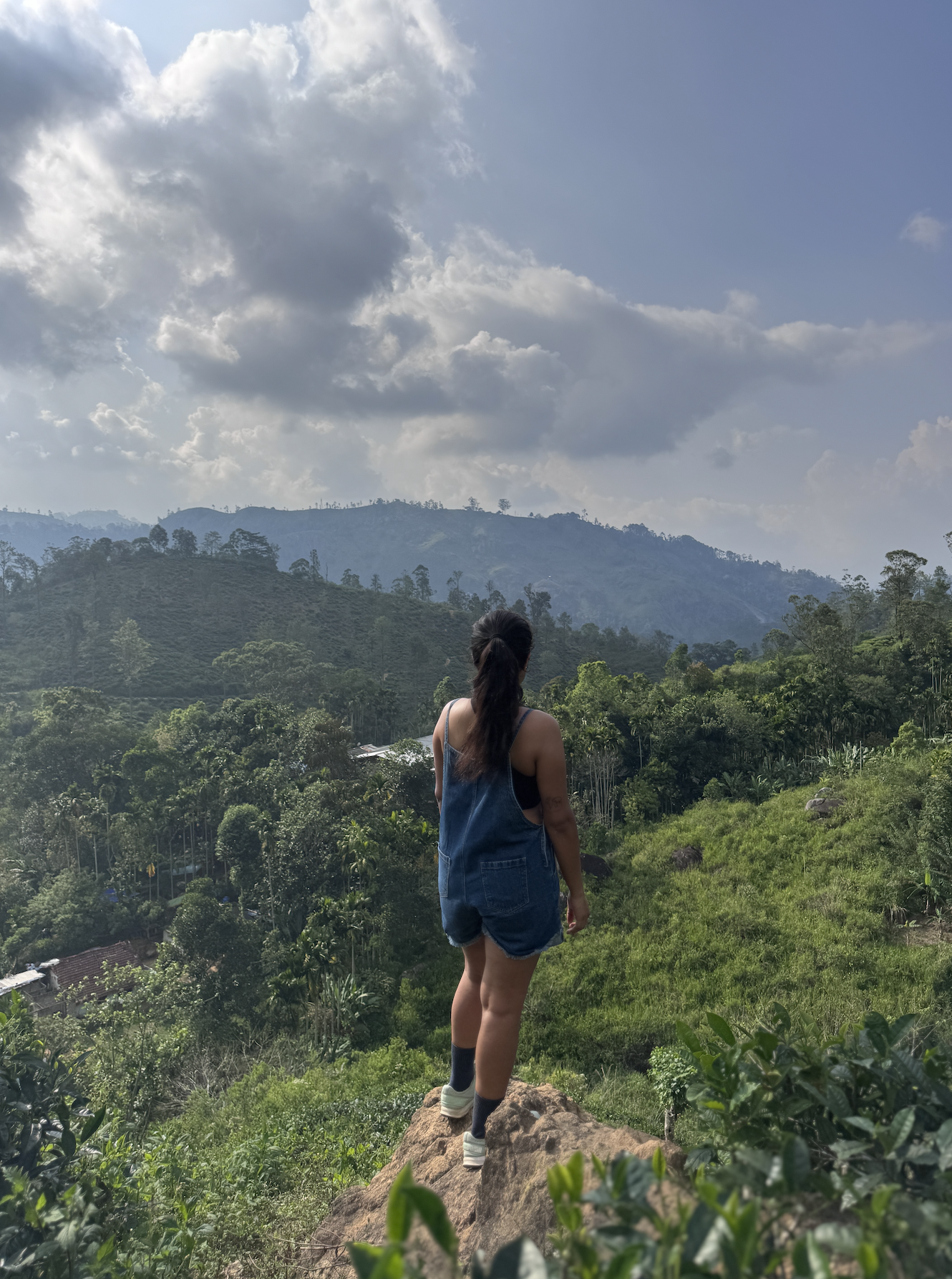
One hour you’re climbing through eucalyptus forest thick with birdsong. The next, you break out onto a bald ridge and the entire valley opens beneath you a rumpled green quilt of tea bushes stitched with redclay footpaths, dotted with the bright saris of pickers working the slopes. An hour later you’re in pine forest so still and cool that locals call this stretch “Little Scotland,” mist clinging to the hollows like something out of a Highlands postcard. By afternoon, you might be looking down at a turquoise reservoir a thousand metres below, or crossing a stream where leeches remind you, gently, that this is still very much a rainforest.
Elevations swing between 1,000 and over 2,000 metres, which means the air stays crisp even when Sri Lanka’s coast is sweltering this is a highland trail, and it feels like one, in the best possible way.
A Paradise for the Wildly Curious
Sri Lanka punches wildly above its weight when it comes to biodiversity, and the Pekoe Trail runs straight through the best of it. Keep your eyes up for some of the country’s 500plus bird species, including endemics like the Sri Lankan Hanging Parakeet and the Sri Lanka Whiteeye. Keep your eyes down, too chameleons, land monitors, and the occasional shy Barking Deer share these paths. And somewhere out there, leopards move through the same forests, rarely seen but always felt, like a secret the mountains are keeping just for themselves.
A Trail That Gives Back
Here’s what makes the Pekoe Trail feel different from so much of modern travel: it wasn’t built for tourists. It was built for the people who already lived there.
Backed by international funding through the EU and USAID, and stewarded today by the nonprofit Pekoe Trail Organisation, the trail was designed from day one to funnel tourism income directly into rural communities homestays, local guides, small familyrun shops rather than into big hotel chains and crowded coastal resorts. Every night you spend in a village guesthouse, every meal you buy from a roadside stall, becomes a small, direct thread of income for the teapickers and mountain families whose ancestors built these very paths.
Maintenance is real and ongoing, too. Trail markers are actively monitored and refreshed, rest points and signage are steadily being expanded, and a dedicated trail app now offers stage details, landmark information, and emergency guidance for hikers on the move. It’s still a young trail, so don’t be surprised if a signpost is occasionally missing or a path forks unexpectedly but ask literally anyone nearby, and you’ll be pointed the right way with a smile, and probably an invitation for tea.
Should You Go?
If you’re the kind of hiker who’s always chasing the next trail before everyone else finds it this is your moment. The Pekoe Trail offers everything the great longdistance walks of the world promise: staggering scenery, genuine physical challenge, deep cultural immersion, rich wildlife, and a real sense of discovery. But it offers something increasingly rare, too solitude. Whole ridgelines to yourself. Village elders who still remember when the trail didn’t exist. Clouds that roll in and swallow you whole, with not another hiker in sight.
Sri Lanka spent years being known only for its beaches and ancient temples. The Pekoe Trail is quietly, beautifully rewriting that story one misty stage at a time.
Lace up. The mountains are waiting, and for now, they’re still wonderfully quiet.
